




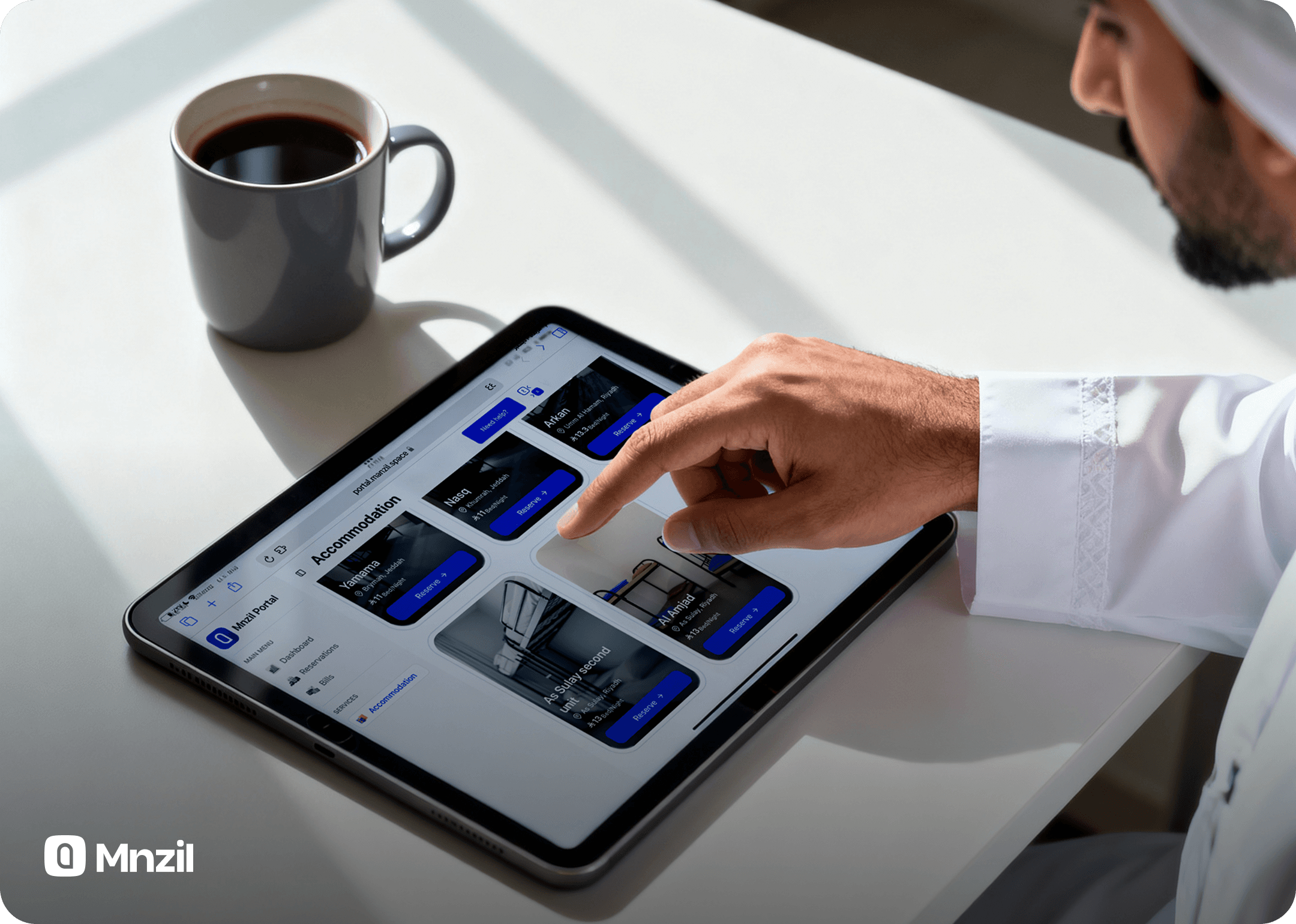
Buying vs Renting Worker Housing in Saudi Arabia: Which Is Right for Your Company
Introduction
Every company employing workers in Saudi Arabia faces this question: should we buy or rent housing? The answer is not the same for everyone. It depends on workforce size, duration of operations, available budget, and expansion plans. The wrong choice costs hundreds of thousands over the long term.
This guide compares buying and renting from every angle: cost, flexibility, operations, and returns, so you can make a decision based on real numbers.
When Buying Is the Right Decision
- Long-term operations. If your company operates in the same city for more than 5 years with no plans to relocate, buying starts outperforming renting after year four or five. Every year after that saves more.
- Large and stable workforce. Companies employing 100 or more workers permanently spend massive amounts annually on rent. A building with capacity for 100-200 workers in north Riyadh costs 2-4 million SAR. Renting equivalent housing costs 400,000-800,000 SAR annually. After 5 years, cumulative rent exceeds the purchase price.
- Investment opportunity. Licensed worker housing is a productive real estate asset. If you reduce your workforce later, you can rent empty floors or wings to other companies. Rental yields on worker housing in Riyadh and Jeddah range between 8-14% annually.
- Full control. When you own the housing, you control everything: maintenance, renovations, modifications, and capacity. You do not need the landlord's approval to install cameras, change room layouts, or add facilities.
When Renting Is the Right Decision
- Temporary or seasonal projects. Construction and project companies that move between sites every one to two years. Buying housing in every city is impractical. Renting gives you the flexibility to relocate without buying and selling costs.
- Variable workforce. If your worker count fluctuates between 30 and 150 depending on season or project volume, renting allows you to adjust capacity easily. More workers means renting additional units. Fewer workers means ending leases on excess units.
- Limited capital. Buying requires a large down payment (usually 20-30% of the property value). If cash is limited or needed for operations, renting preserves capital.
- New company or testing phase. If you are entering a new market or testing the scale of operations, renting reduces risk. Do not buy until you are certain operations will continue at the same location.
- Cheap rental markets. In some Saudi cities (especially medium and small cities), worker housing rents are very low compared to purchase prices. In these cases, renting is cheaper even over the long term.
Cost Comparison: Real Numbers
Here is a realistic example: a company needing housing for 80 workers in north Riyadh.
Buying costs. Building price: 2,500,000 SAR. Transfer and registration fees: 125,000 SAR (5%). Furnishing and setup: 200,000 SAR. Annual maintenance: 50,000 SAR. Annual insurance: 15,000 SAR. Year one total: 2,890,000 SAR. 5-year total: 3,215,000 SAR. 10-year total: 3,540,000 SAR.
Renting costs. Annual rent: 500,000 SAR. Initial furnishing and setup: 150,000 SAR. Annual maintenance (tenant share): 20,000 SAR. Year one total: 670,000 SAR. 5-year total: 2,750,000 SAR. 10-year total: 5,350,000 SAR.
Break-even point. In this example, break-even falls around year six. After 6 years, buying starts saving money. But this does not account for: annual rent increases (typically 5-10%), the property market value at resale, or rental income if you lease part of it.
With 7% annual rent escalation factored in, the break-even point moves forward to year five.
What to Consider When Buying
- Location. Buy in industrial or commercial zones where worker housing is permitted. Verify the land classification through Balady before purchasing. Buying in a purely residential zone means difficulty obtaining a worker housing license.
- Licensing. Confirm the building is licensed or licensable as worker housing before buying. Some buildings need costly modifications (emergency exits, fire suppression systems, room partitioning) to meet Balady and Civil Defense requirements.
- Structural condition. Hire a civil engineer to inspect the building before purchase. Check: structural integrity, plumbing and electrical condition, heat and water insulation, building age and date of last major maintenance.
- Financing. Saudi banks finance commercial properties at 60-70% of value. Monthly installments should be lower than the equivalent monthly rent for buying to make sense. Compare offers from at least 3-4 banks.
- Exit plan. What if you need to sell the building after 3 years? Is the local market active? Is the building easy to sell or convert to another use? Buildings in industrial areas are easier to sell as worker housing. Buildings in remote areas may sit on the market for months.
What to Consider When Renting
- Lease duration. A one-year lease gives flexibility but no price guarantee. A 3-5 year lease locks in rent and protects against increases. Try to negotiate a long lease with an early exit clause requiring 3-6 months notice.
- Terms and restrictions. Read the contract carefully: does it allow worker housing? What is the maximum capacity? Who is responsible for maintenance? Can you modify the interior layout? Are there restrictions on nationalities or entry hours?
- Balady approval. Even if the landlord agrees, you need a worker housing license from Balady. Some buildings in residential zones cannot obtain one. Confirm before signing the contract, not after.
- Hidden costs. Security deposit (usually one or two months). Utility connection fees (electricity and water in tenant's name). Installations required by Balady or Civil Defense. Emergency repair costs if the landlord is slow to respond.
The Third Option: Partnership or Rent-to-Own
Some real estate companies offer alternative models.
- Rent-to-own. You pay monthly rent above market rate, and after a set period (7-10 years) ownership transfers to you. Advantage: no large down payment needed. Disadvantage: total cost is higher than direct purchase.
- Land partnership. You build the housing on the landowner's property under a partnership agreement. The owner provides the land, you provide the construction. Revenue is split at an agreed ratio. Suitable for companies that want to invest without the cost of purchasing land.
- BOT (Build, Operate, Transfer). You build housing on someone else's land, operate it for a set period (10-15 years), then transfer ownership to the landowner. During the operating period, you are the sole beneficiary.
Quick Comparison Table
- Buying: high capital required, low monthly cost (maintenance only), low flexibility, full control, suited for long-term operations.
- Renting: low capital required, fixed high monthly cost, high flexibility, limited control, suited for temporary projects.
- Rent-to-own: medium capital required, high monthly cost, medium flexibility, control increases gradually, suited for those wanting ownership without full liquidity.
Decision Steps
- Step one: determine operation duration. Less than 3 years: rent. 3-5 years: study the options. More than 5 years: buying deserves serious consideration.
- Step two: calculate total cost. Do not compare purchase price to monthly rent. Calculate the total cost for 5 and 10 years for both options including maintenance, insurance, and setup.
- Step three: assess flexibility needs. Do you need to change location? Is the headcount stable? Is there a chance of scaling down? The more flexibility you need, the more attractive renting becomes.
- Step four: consult a specialist. A real estate advisor who understands the worker housing market can save you from costly mistakes. Especially in property valuation, price negotiation, and license verification.
Conclusion
There is no single answer that fits everyone. Buying is better for stable companies with long-term operations and a fixed worker count. Renting is better for temporary projects, mobile companies, and limited budgets. Alternative models (rent-to-own, partnerships, BOT) suit those who want ownership without full risk. Start by calculating the total cost for 5 years for both options. The numbers will guide you to the right decision.