General
July 6, 2026
Starting a Worker Housing Business in Saudi Arabia: Investment & Setup Guide
Demand for worker housing in Saudi Arabia is rising sharply due to Vision 2030 mega projects, construction sector expansion, and tighter government enforcement of housing regulations. Building or operating a worker housing project is a real investment opportunity, but it requires careful planning and a clear understanding of licensing, costs, and daily operations.
Starting a Worker Housing Business in Saudi Arabia: Investment & Setup Guide
Introduction
Demand for worker housing in Saudi Arabia is rising sharply due to Vision 2030 mega projects, construction sector expansion, and tighter government enforcement of housing regulations. Building or operating a worker housing project is a real investment opportunity, but it requires careful planning and a clear understanding of licensing, costs, and daily operations.
This guide explains how to start a worker housing business from scratch: from feasibility study to daily operations.
Why Invest in Worker Housing Now
The Saudi market is driven by three demand waves. First, Vision 2030 mega projects (NEOM, The Red Sea, Qiddiya, ROSHN) need hundreds of thousands of workers at remote sites and in major cities. Second, government decisions to relocate worker housing out of residential neighborhoods create demand for new purpose-built locations. Third, stricter enforcement pushes companies to seek licensed, ready housing rather than managing their own.
Market Size. Saudi Arabia has over 8 million expatriate workers. A large portion needs collective housing. Major cities (Riyadh, Jeddah, Dammam) absorb the biggest share, but secondary cities and project sites have clear supply gaps.
Types of Worker Housing Projects
Building a New Compound. The largest investment with the highest returns. You buy or lease land in an industrial zone or area designated for collective housing. You build residential buildings that meet Balady and Ministry of Human Resources specifications. You operate the compound and rent by bed or room to companies. Cost: from SAR 5 million for a 200-bed compound to SAR 50 million for a 2,000-bed facility. Payback period: 3-7 years depending on location and occupancy.
Converting an Existing Building. You buy or lease a commercial or residential building and convert it to worker housing. Lower cost than new construction. Requires a change-of-use approval from the municipality. Suitable for smaller capacities (50-200 beds). The challenge: many municipalities have stopped issuing conversion permits in residential neighborhoods.
Buying an Existing Compound. You purchase an operating project from another investor. The advantage is starting with revenue from day one. Requires thorough due diligence: building condition, occupancy rates, corporate contracts, and licenses. Risks include old contracts with low prices and buildings needing major maintenance.
Management-Only Model. You do not own the building but manage it. Management contract with the owner for a percentage of revenue or a fixed fee. Requires operational expertise more than capital. Suitable for starting with lower risk.
Feasibility Study: What to Calculate
Location Selection. Location determines project success. Look for: an industrial zone or area designated for collective housing (essential for licensing). Proximity to construction projects or industrial areas (the demand source). Available infrastructure (electricity, water, sewage, roads). Distance from upscale residential neighborhoods (less opposition). Check municipal development plans to ensure the area will not be rezoned.
Capital Cost Calculation. Land: SAR 300-800 per square meter in industrial areas. Construction: SAR 1,500-3,000 per square meter (including finishing). Furnishing: SAR 3,000-6,000 per bed (bed, locker, mattress, basic items). Shared facilities: 15-25% of construction cost (kitchen, laundry, common room, prayer room). Licensing and consulting: SAR 100,000-300,000. Example: A 500-bed compound in a Riyadh industrial area. Land (5,000 sqm): SAR 2.5 million. Construction: SAR 7.5 million. Furnishing: SAR 2 million. Facilities: SAR 1.5 million. Licensing: SAR 200,000. Total: approximately SAR 13.7 million.
Revenue Projections. Bed price: SAR 300-800 per month depending on location and services. 500 beds at an average of SAR 450 = SAR 225,000 per month. Expected occupancy: 70-85% in the first year, 85-95% after stabilization. Annual revenue at 80% occupancy: SAR 2.16 million. Additional services (catering, laundry, transport): add 30-60% above base accommodation revenue.
Operating Expenses. Salaries (security, cleaning, maintenance, management): 40-60% of revenue in the first two years, then the ratio decreases. Electricity and water: 15-25% of revenue. Maintenance: 5-10%. Marketing and client acquisition: 3-5%. Insurance: 2-3%.
Break-Even Point. Using the numbers above: annual operating expenses approximately SAR 1.5 million. Annual net profit (at 80% occupancy): approximately SAR 660,000. Break-even: approximately 5 years without financing, or 6-7 years with loan payments.
Required Licenses
Building Permit. Submit engineering plans approved by a licensed engineering office. The site must be classified for commercial, industrial, or collective housing use. Processing time: 2-6 months.
Municipal Operating License. After completing construction, apply for an operating license. Requires the building to match approved plans and collective housing specifications. Includes a field inspection by the municipality.
Civil Defense Safety Certificate. Inspection of fire suppression systems, alarms, and emergency exits. Required before operations begin. Renewed annually.
Qiwa Platform Registration. The Ministry of Human Resources requires electronic registration of collective housing. Housing data, capacity, and actual worker numbers must be updated regularly.
Food Service License. If you provide meals, you need a separate permit from the municipality and SFDA.
Daily Operations
Core Team. Housing manager (responsible for everything). Cleaning supervisor plus cleaning crew. Maintenance technician (electrical and plumbing). Security guards (two or three shifts). Reception and registration officer. Food service supervisor (if providing meals).
Daily Routines. Worker check-in and check-out. Morning inspection round (cleanliness, maintenance, safety). Receiving and resolving complaints. Coordinating with client companies. Documenting everything (daily reports, maintenance logs, inspection records).
Key Metrics to Track. Occupancy rate (target: above 85%). Client turnover rate (target: below 15% annually). Complaints per 100 beds per month. Maintenance cost per bed per month. Response time for urgent requests.
Marketing and Client Acquisition
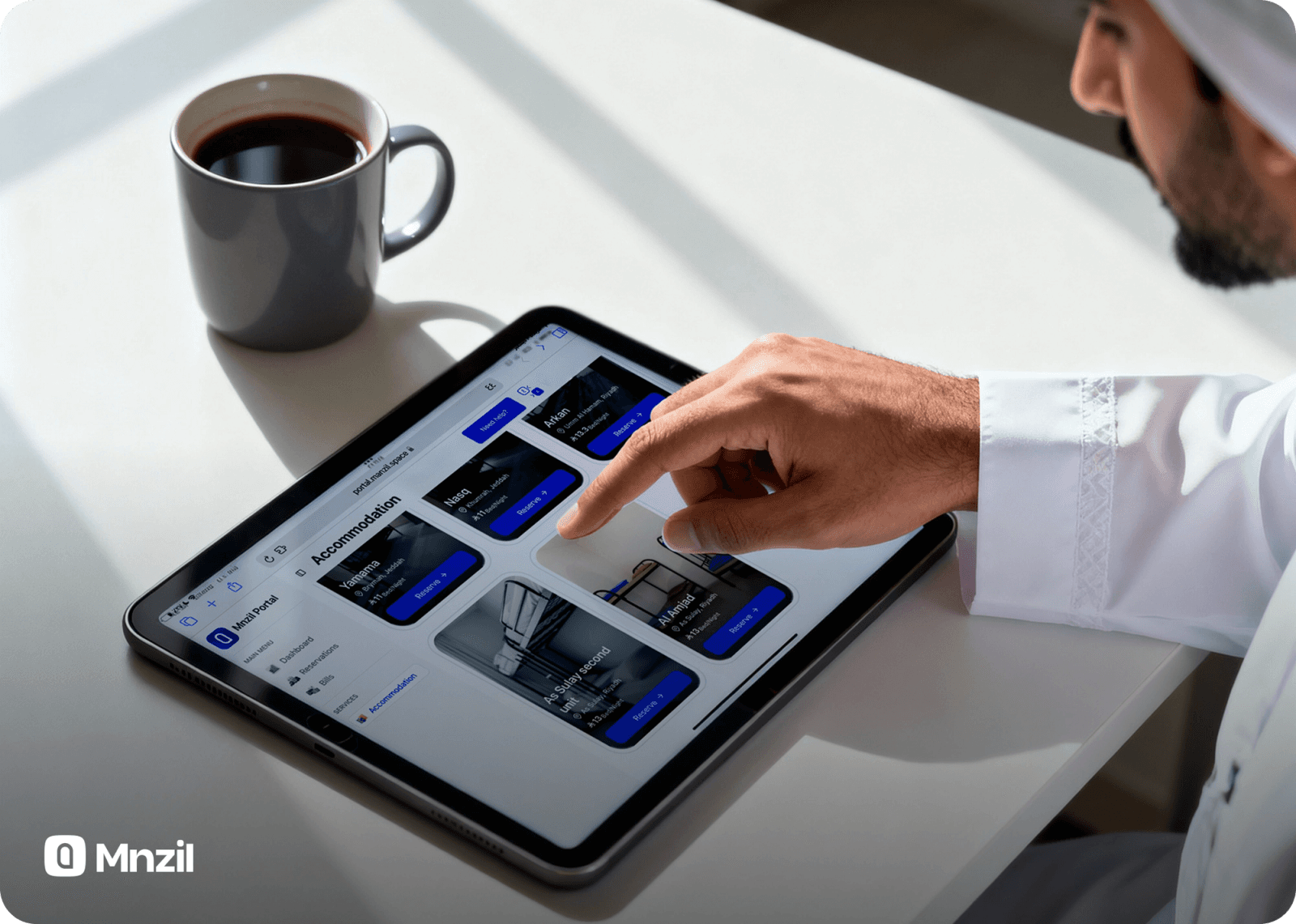
Your clients are companies, not individuals. Marketing differs from standard housing. Most effective channels: direct relationships with project managers and HR officers. Presence on approved vendor lists of major companies. Specialized worker housing platforms (like Mnzil). Participation in construction and contracting exhibitions. Referrals from existing clients (strongest source after stabilization).
Corporate Contracts. Usually annual minimum contracts. Clear terms: number of beds, included services, early termination conditions. Payment security: advance payment or bank guarantee for large contracts. Flexibility to increase or decrease beds based on project needs.
Risks to Watch
Licensing Delays. Especially in new or unclassified areas. Add 6 extra months to your plan.
Occupancy Fluctuation. Construction projects have a start and an end. Diversifying clients across construction companies, service companies, and industrial companies reduces risk.
Tightening Regulations. The government continuously raises standards. Design your project above current minimums to avoid future modification costs.
Price Competition. Some operators lower prices to attract clients at the expense of quality. Do not compete on price alone. Large companies prefer compliant, high-quality housing even at a higher price.
Conclusion
A worker housing project in Saudi Arabia is a profitable investment when built on solid foundations. Start with a detailed feasibility study covering location, licensing, and real costs. Do not underestimate operating expenses. Design above minimum standards. Diversify your clients. Focus on operational excellence because reputation in this sector is the strongest marketing tool.
Want to get in touch?